Biker patches are not decorations. To the uninitiated they look like colorful embroidered fabric sewn onto a leather vest. To those inside motorcycle culture, they are a visual language — communicating club affiliation, rank, territory, achievements, and personal history in a way that every rider immediately understands.
Getting patch etiquette wrong is not just a fashion faux pas. In the wrong setting, wearing the wrong patch, or wearing a patch the wrong way can lead to serious conflict. This guide breaks down everything you need to know about biker patch rules — whether you are a new rider, an aspiring club member, or someone designing custom patches for a motorcycle club.
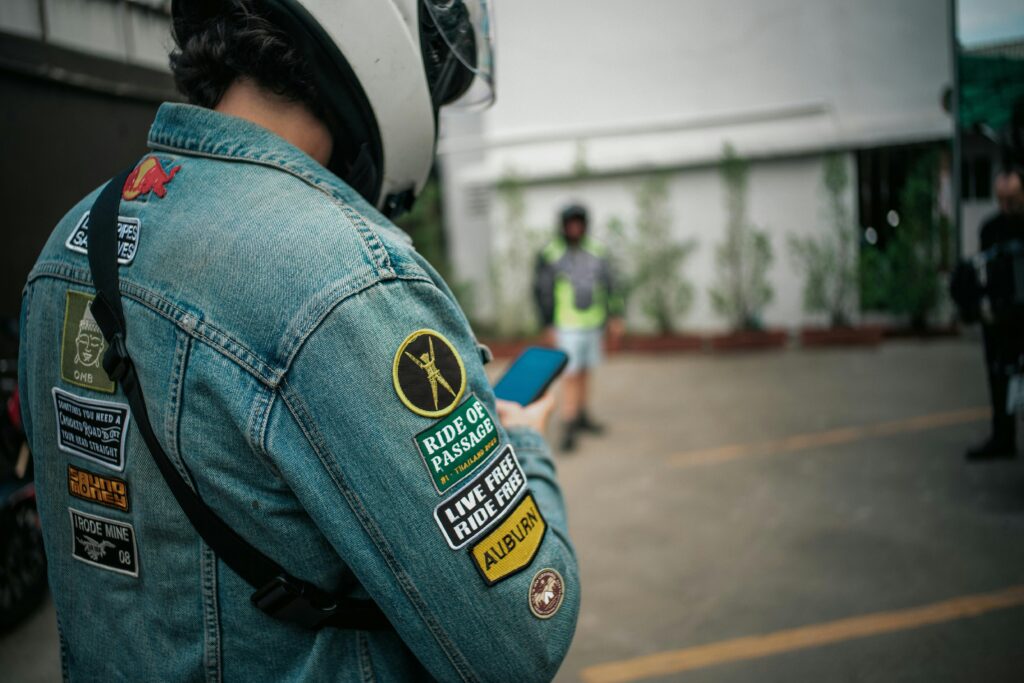
The History Behind Biker Patches
Biker patch culture traces its roots to post-World War II America. Veterans returning home formed motorcycle clubs as a way to maintain the brotherhood and freedom they had experienced during the war. The American Motorcyclist Association (AMA) was founded in 1924 and sanctioned many of these clubs.
In 1947, at the Hollister Rally in California, a smaller group of riders — later called outlaw clubs — broke from AMA norms and began establishing their own identity. The most significant visual marker of this split was the three-piece patch, which outlaw clubs adopted to differentiate themselves from AMA-sanctioned riding clubs. From that moment, biker patches became one of the most loaded and regulated symbols in any subculture in America.
Types of Biker Patches and What They Mean
One-Piece Patches
A single patch worn on the back of a vest, typically showing a club name, logo, or riding group emblem. One-piece patches are associated with riding clubs (RCs), independent riders, and hobbyist motorcycle groups. They carry the least amount of cultural weight and are generally safe for non-MC members to wear without issue.
Two-Piece Patches
Two-piece patches consist of a top rocker with the club name and a center emblem, without a bottom rocker showing territory. In MC culture, two-piece patches often indicate a club in a transitional or probationary state — working toward full recognition. Wearing a two-piece patch that mimics an existing club without membership is considered highly disrespectful and should be avoided.
Three-Piece Patches (Colors)
The three-piece patch — or colors — is the most significant and most regulated patch configuration in biker culture. It consists of:
- Top rocker: the club name, curved along the top of the back
- Center patch: the club’s main emblem or logo, the centerpiece of the colors
- Bottom rocker: the territory or chapter location, curved along the bottom
Three-piece patches are associated with established motorcycle clubs, both AMA-sanctioned and outlaw. They represent full membership, earned loyalty, and territorial identity. Under no circumstances should a non-member wear a three-piece configuration that resembles an existing MC’s colors.
| Patch Type | Who Wears It | Risk If Worn Without Affiliation |
| One-piece | Riding clubs, independents, hobbyists | Low — generally acceptable |
| Two-piece | Clubs in transition, some MCs | Moderate — research the specific design |
| Three-piece (colors) | Established MCs, outlaw clubs | High — serious breach of etiquette |
Patch Placement Rules on the Vest
Where patches are placed on a vest or cut is as meaningful as the patches themselves. Here is the standard placement map used across most MC culture:
Back of the vest
- Top rocker: club name, spanning the upper back
- Center patch: main club emblem, center of the back
- Bottom rocker: territory or chapter, lower back
- MC patch (if applicable): small patch below or beside the center emblem, indicating motorcycle club status
Front of the vest — left chest
- Club name patch or officer title (President, VP, Sergeant-at-Arms, etc.)
- Membership rank patches (Prospect, Hangaround, Full Member)
- Chapter or region identifier
Front of the vest — right chest
- Memorial patches for fallen members
- Event patches from rallies or runs
- Achievement patches earned through club activities
Other placements
- Side panels: additional designations, awards, or specialized role patches
- Sleeves: some clubs use sleeve patches for chapter numbers or run awards
- Collar: rarely used — some clubs place small patches near the collar for specific designations
Never place a bottom rocker on your vest unless you are a full member of the club that owns that territory. A non-member wearing a bottom rocker in a club’s territory is considered one of the most serious breaches of biker etiquette.
The Core Rules of Biker Patch Etiquette
1. Never wear another club’s colors
This is the most fundamental rule. Wearing the colors of a motorcycle club you are not a member of — or colors that closely resemble them — is considered an act of disrespect that can have serious real-world consequences. Even an accidental resemblance should be avoided. If you are designing custom patches for a club, always research existing colors in the region before finalizing a design.
2. Respect territorial boundaries
Each motorcycle club has an established territory, and wearing colors within another club’s territory without permission or acknowledgment is a significant breach of etiquette. Visiting riders — particularly those wearing club colors — are expected to show respect when passing through another club’s territory, sometimes by checking in with the local club.
3. Never touch another rider’s patches without permission
A biker’s vest and patches are deeply personal. Touching, adjusting, or handling another rider’s patches without explicit permission is considered a major sign of disrespect. This applies to friends, family, and strangers alike. The patches are earned — they are not casual accessories to be handled freely.
4. Patches must be earned, not bought
In established motorcycle clubs, patches are awarded — not purchased. Each patch represents something earned through time, loyalty, effort, or achievement. Buying a club-style patch and wearing it without going through the proper channels undermines this entire system and marks the wearer as someone who does not understand or respect the culture.
5. Colors stay with the club
When a member leaves a club — whether voluntarily, involuntarily, or due to death — their colors are returned to the club. Colors belong to the club, not the individual. A former member wearing their old colors after leaving is considered a serious violation of club rules and can lead to confrontation.
6. Prospect and hangaround patches have their own rules
New riders working their way toward full membership wear prospect or hangaround patches. These are earned designations that cannot be self-assigned. The prospect period is a test of loyalty, conduct, and commitment — and the patch reflects that status. Wearing a prospect patch without going through the actual prospect process is not acceptable.
7. MC patches are not for riding clubs
The small “MC” patch worn by motorcycle clubs indicates formal MC status — a designation that carries significant cultural weight. Riding clubs (RCs), which are casual groups without the formal structure of an MC, do not wear MC patches. Wearing an MC patch without actual MC status causes confusion and disrespect.
Independent Riders: What You Can and Cannot Wear
If you ride independently and are not affiliated with any motorcycle club, you have significant freedom in what patches you wear — with a few important boundaries:
| Safe to Wear | Avoid Wearing |
| Personal achievement patches | Three-piece patch configurations |
| Event and rally patches | Bottom rockers claiming territory |
| Humor and novelty patches | Colors resembling any established MC |
| Military service patches | The ‘1%’ patch (MC-specific symbol) |
| One-piece riding club patches | Any patch with an existing club’s name or emblem |
| Memorial patches | MC designation patch |
Tip for independent riders: If you want to wear a distinctive back patch, stick to a one-piece design with original artwork that does not use a rocker-style layout. This keeps you clearly outside MC territory while still expressing your identity.
The 1% Patch — What It Means
The 1% patch is one of the most recognized and most misunderstood symbols in biker culture. It originates from an AMA statement following the 1947 Hollister incident, in which the AMA reportedly claimed that 99% of motorcyclists were law-abiding citizens. Outlaw clubs adopted the remaining 1% as their badge of honor — a declaration that they operated outside mainstream society’s rules.
Wearing a 1% patch without belonging to an outlaw motorcycle club is not just a fashion mistake — it is a declaration of identity that carries real-world implications. Do not wear this patch unless you understand exactly what it communicates and are prepared to stand behind it.
Designing Custom Patches for a Motorcycle Club
If you are a club officer or member responsible for commissioning custom patches, here are the key considerations before placing an order:
- Research existing colors in your region — avoid any design that resembles an established club’s colors, even accidentally
- Establish your patch configuration — decide whether your club uses one-piece, two-piece, or three-piece before designing
- Keep colors distinctive — your center emblem, rocker colors, and border colors should be unique to your club
- Plan all membership ranks — design patches for full members, prospects, officers, and any specialized roles upfront
- Choose quality materials — embroidered patches for vests need to be durable, colorfast, and properly backed for sewing or iron-on application
- Work with a digitizing service — any embroidered patch starts with a digitized file. Quality digitizing ensures your emblem looks sharp and holds up over years of riding
At Gem Punch, we have produced custom patches for motorcycle clubs across the US and internationally. We understand the culture and the importance of getting the design right — both artistically and respectfully. Our team can help you design a distinctive set of colors that stands on its own.
How to Order Custom Biker Patches the Right Way
When ordering custom patches for a motorcycle club, the process matters as much as the design. Here is what to prepare before placing an order:
- Final artwork or design concept — vector files preferred (AI, EPS, SVG)
- Patch dimensions — back patches are typically 10–12 inches wide; front patches 3–4 inches
- Thread color selections — choose colors that match your club’s established palette
- Backing type — sew-on is standard for vest patches; iron-on is available but less durable for heavy use
- Quantity — most custom patch manufacturers have minimum order quantities, typically 10–50 pieces
- Border style — merrowed (overlocked) borders are standard for MC patches
Frequently Asked Questions
Can I wear biker patches if I am not in a motorcycle club?
Yes — independent riders can wear patches that do not mimic or reference established motorcycle club colors. Novelty patches, personal achievement patches, event patches, and one-piece riding club patches are all acceptable. Avoid any configuration that looks like a three-piece MC setup.
What happens if I wear another club’s colors by mistake?
Intent matters but is difficult to prove in the moment. If you find yourself in a situation where your patches are being questioned by club members, the right approach is to be respectful, honest, and non-confrontational. Remove the offending patch immediately if asked. Ignorance of the rules is not always accepted as an excuse in MC culture.
Can women wear biker patches?
Yes — women’s chapters of motorcycle clubs exist, and female riders wear patches according to the same rules as male members. Female riders who are affiliated with a club as partners or supporters of members sometimes wear a ‘Property of’ patch, though this is a personal choice and increasingly less common in modern clubs.
How much do custom biker patches cost?
Custom embroidered biker patches typically range from $3 to $15 per patch depending on size, complexity, and quantity ordered. Back patches with large embroidered designs cost more per piece at low quantities, but the per-piece price drops significantly for orders of 50 or more. Rush orders are available at an additional fee.
What is the difference between a motorcycle club and a riding club?
A motorcycle club (MC) is a formal organization with a structured hierarchy, membership process, colors, and territorial identity. A riding club (RC) is a more casual group focused on social riding without the formal structure of an MC. RCs use one-piece patches and do not use the MC designation.
Final Thoughts
Biker patches are one of the most meaningful symbol systems in any subculture. They represent years of loyalty, earned respect, and cultural identity that goes back over 75 years. Whether you are a new rider, a club officer commissioning a fresh set of colors, or simply someone interested in the culture — understanding and respecting these rules is essential.
The rules exist not to be restrictive, but to protect a culture built on brotherhood, trust, and earned respect. Approach them with that understanding and you will navigate the world of biker patches with confidence.
Need custom biker patches for your club or riding group? Gem Punch has produced patches for motorcycle clubs worldwide — embroidered, PVC, woven, and leather. We understand the culture and deliver production-quality patches that stand up to the road. Get a free quote at gempunch.com.