You just ordered beautiful custom patches. They arrived yesterday. Now you’re staring at them thinking: “Do I heat press these, or hand sew them?”
It’s a more important decision than you might think.
Because the method you choose Heat Press vs. Sewing Patches determines:
- How long the patches actually last (5 years vs. 10+ years)
- How much time you’ll spend (2 minutes vs. 30 minutes)
- How professional they look
- How much it costs overall
I’ve seen customers choose the wrong method and regret it months later when patches start peeling off. I’ve also seen customers overthink this and spend 10 hours hand sewing when heat pressing would have been perfect.
This guide breaks down both methods honestly—no sales pitch, just the real tradeoffs so you can choose what actually works for your situation.
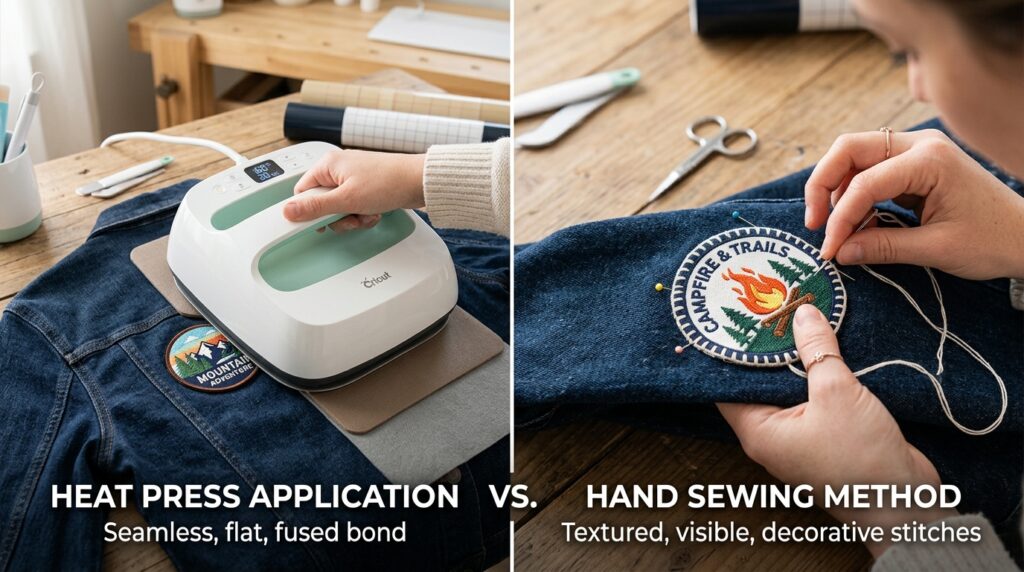
The Quick Answer (If You’re In A Hurry)
Heat press if you:
- Have a heat press machine already
- Need to apply 50+ patches quickly
- Ordered patches with adhesive backing
- Want fastest possible application (1-2 min per patch)
- Are applying to standard cotton/canvas
Hand sew if you:
- Want maximum durability (10+ years)
- Ordered embroidered patches without adhesive backing
- Are applying to leather, delicate, or specialty fabrics
- Enjoy craftsmanship and don’t mind the time investment
- Want to be absolutely certain patches never peel
Method #1: Heat Press — Speed & Convenience
How Heat Pressing Actually Works
Heat press machines combine two things: heat + pressure.
The process:
- You position your patch on the garment
- Lower the heat press top (it heats up to 300-350°F)
- Apply consistent pressure for 15-20 seconds
- Lift the top and let cool
- Patch is permanently bonded via activated adhesive backing
The heat melts the adhesive on the patch backing, which glues it to the fabric. When it cools, it’s hardened and permanent.
Simple. Effective. Fast.
Why Heat Press Is Popular (The Real Reasons)
Speed is real: You can apply a patch in literally 2 minutes. If you’re doing 100 patches, that’s 3-4 hours. Hand sewing 100 patches? That’s 40+ hours.
Professional appearance: When done right, heat-pressed patches look perfect. Perfectly flat, perfectly centered, perfectly finished.
No skill required: Hand sewing requires practice. Heat pressing? Lower the machine, walk away, patch is done. Anyone can do it.
Bulk production: If you’re a company applying patches to 500 employee uniforms, heat press is the only realistic option.
Equipment investment: If you already have a heat press, the per-patch cost is tiny (just thread and patch cost).
The Heat Press Reality: What Actually Limits It
Not all patches work. Heat press only works on patches with adhesive backing. If you ordered embroidered patches without heat-seal backing, heat pressing won’t work—you’ll waste time and potentially damage the patch.
Not all fabrics are safe. Delicate fabrics (silk, satin, cashmere) can be damaged by heat. Synthetic fabrics can melt. If you’re applying to leather, heat can damage it permanently.
Equipment cost is real. A household heat press runs $200-500. Commercial? $1,000+. If you’re only applying 10 patches ever, that’s not worth it.
Adhesive degrades. Here’s the thing nobody talks about: the adhesive backing that makes heat pressing fast is also what eventually fails. More on that in durability comparison below.
Peeling risk over time. If edges aren’t perfectly sealed, they can peel after months or years. If you don’t apply enough heat or pressure, it fails sooner.
Heat Press Durability: The Truth
Typical lifespan: 5-10 years with daily wear
Here’s what actually happens:
Year 1-3: Perfect. No issues. Patch looks great.
Year 4-5: Edge peeling starts (usually). Subtle at first. Noticeable later.
Year 6-10: Significant peeling. Patch might separate completely.
Why degradation happens:
- Adhesive has a lifespan (unlike thread, which is permanent)
- Repeated washing/drying stresses the adhesive bond
- Temperature changes cause expansion/contraction
- Normal wear and friction eventually cause failure
- Sweat and chemicals weaken adhesive
Real world: People report patches holding strong for 5-7 years typically. After that, edges start failing.
Heat Press Best Practices (For Better Longevity)
Temperature matters: Too hot damages the patch. Too cool doesn’t activate adhesive. Check patch specs—typically 320-350°F.
Pressure matters: Firm, even pressure across entire patch. Inconsistent pressure = inconsistent adhesion.
Time matters: 15-20 seconds typically. Longer doesn’t help, just wastes time.
Let it cool: Don’t peel or move patch while hot. Heat and pressure work together. Moving it breaks the bond.
Test first: Try on scrap fabric before precious garments. Mistakes cost you.
Don’t skip the heat seal: Some people try to use iron at home instead of real heat press. Doesn’t work as well. The even pressure of a machine is key.
Method #2: Hand Sewing — The Durability Choice
How Hand Sewing Actually Works
Hand sewing is simpler than heat pressing (no equipment needed), but requires more time and a bit of skill.
The process:
- Thread your needle with thread matching the patch color
- Position patch on garment
- Sew around the entire patch perimeter with small, even stitches (1/4 inch apart)
- Use hidden stitch method (go through back of garment fabric, not visible from front)
- Tie off securely at the end
- Done
The thread physically passes through both the patch and the garment fabric, creating a mechanical bond that’s incredibly strong.
Why Hand Sewing Produces Patches That Last
Thread doesn’t degrade. Unlike adhesive that has a lifespan, good quality thread lasts indefinitely. Decades, even.
Multiple redundancy. If one stitch fails, 20 others still hold. The patch won’t come off because one thread broke.
Mechanical bond. You’re not relying on chemistry (adhesive). You’re relying on physical stitches that lock the patch to fabric.
No temperature sensitivity. Hot sun, cold weather, washing—none of it affects thread. It just keeps holding.
Works on any fabric. You can hand sew leather, silk, denim, anything. No heat risk.
The Hand Sewing Reality: Why It Takes Time
Speed. Hand sewing a patch takes 20-30 minutes depending on size. If you have 100 patches, that’s 40+ hours. Many people don’t have that time.
Skill required. Your first patch might look rough. Your 10th will look much better. Stitching quality improves with practice.
Visible stitches. If your thread color doesn’t match perfectly, people see the stitches. That’s not bad (many people like the visible craftsmanship), but it’s different from the seamless look of heat pressing.
Labor cost. If you’re paying someone to hand sew, it costs $3-8 per patch in labor. That adds up with volume.
Physical effort. Needle, thimble, sitting there for 30 minutes. Some people enjoy it. Some find it tedious.
Hand Sewing Durability: The Reality
Typical lifespan: 10-15+ years with daily wear
Here’s what happens:
Year 1-5: Perfect. No issues.
Year 5-10: Still perfect. No degradation.
Year 10-15: Minor wear on thread, but patch doesn’t come loose. Still holding strong.
Year 15+: Patch might eventually fail from thread degradation, but that’s decades of wear.
Why it lasts so long:
- Thread is permanent (doesn’t have expiration date)
- Multiple stitches provide redundancy
- Mechanical bond is strongest type of bond
- No chemical degradation
Real world: People report hand-sewn patches lasting 15+ years easily. Some never fail—they outlast the garment.
Hand Sewing Best Practices (For Optimal Results)
Thread quality: Use good quality thread (not cheap thread). Better thread = stronger bond.
Stitch density: Stitches should be about 1/4 inch apart. Closer = stronger, but takes longer. 1/4″ is sweet spot.
Thread color: Match to patch if you want invisible stitches. Use clear/neutral thread if you want hidden stitches.
Hidden stitch method: Sew through the back of the garment (not visible from front). Creates cleaner appearance.
Double stitches: For high-wear areas (corners, edges), you can go around twice for extra strength.
Tension: Medium tension. Not tight (puckers fabric), not loose (patch pulls off).
Reinforce corners: Make extra stitches at patch corners—they experience most stress.
Heat Press vs. Sewing: Direct Comparison
| Factor | Heat Press | Hand Sewing |
|---|---|---|
| Durability | 5-10 years | 10-15+ years |
| Speed | 2 min/patch | 20-30 min/patch |
| Ease | Very easy | Requires skill |
| Equipment cost | $200-500 | Minimal (needle, thread) |
| Labor cost (per patch) | $0 (if DIY) | $3-8 (if hired) |
| Professional appearance | Excellent | Excellent |
| Works on all patches | No (needs adhesive) | Yes |
| Works on all fabrics | No (heat risk) | Yes |
| Skill required | Minimal | Medium |
| Long-term cost | Higher (replacements) | Lower |
| Best for bulk orders | Yes (50+ patches) | No (too slow) |
| Best for durability | No | Yes |
Which Patches Need Which Method?
Embroidered Patches (Traditional)
Best method: Hand sewing
Why: Already designed for sewing. Heat can damage embroidered stitches.
Heat press: Possible if they have adhesive backing, but not ideal.
Recommendation: Hand sew for quality patches.
Woven Patches (Premium)
Best method: Hand sewing
Why: Fine weave can be damaged by excessive heat. Sewing preserves integrity.
Heat press: Risky. High heat might flatten or damage fine weave.
Recommendation: Hand sew. They’re premium patches—treat them that way.
PVC Patches (Modern)
Best method: Heat press (if adhesive backed) OR hand sewing (always works)
Why: Many PVC patches designed with heat-seal backing. If no adhesive, hand sewing works.
Choice depends on: Whether they have backing and your preference.
Recommendation: Check patch specs. If they have adhesive backing, heat press is fine. Otherwise, hand sew.
Chenille Patches (Fuzzy)
Best method: Hand sewing ONLY
Why: Heat can flatten the fuzz or damage backing. Sewing preserves fuzzy texture.
Heat press: NOT recommended—damages patch.
Recommendation: Only hand sew. Protect your investment.
Leather Patches (Premium)
Best method: Hand sewing ONLY
Why: Heat damages leather permanently. Sewing is only safe option.
Heat press: NOT suitable. Heat will damage leather irreversibly.
Recommendation: Hand sew. Leather requires careful handling.
Dye Sublimated Patches (Photo-realistic)
Best method: Heat press (if adhesive backed) OR hand sewing
Why: Many have heat-seal backing. Check specs first.
Choice: Depends on backing and your preference.
Recommendation: Check with manufacturer. Usually designed for heat press, but hand sewing works too.
Cost Comparison: The Math
Heat Press Method (100 Patches)
Equipment: $250 heat press (one-time)
Per-patch materials: $0.10-0.20
Per-patch labor: $0 (DIY)
Total materials: $10-20
Total cost: $260-270 for 100 patches
Per-patch cost: $2.60-$2.70
Breakeven: Need to apply ~100+ patches to justify equipment cost
Hand Sewing Method (100 Patches)
Equipment: $10 (needle, thread, thimble)
Per-patch labor: 30 minutes × $0 (DIY) = nothing
Per-patch materials: $0.10
Total materials: $10
Total labor time: 50 hours
Total cost: $10 for materials + 50 hours labor
Per-patch cost: If DIY, just $0.10. If you hire someone at $10/hour, adds $5/patch = $510 total
Breakeven: DIY is cheaper unless you’re paying for labor
Long-Term Cost Comparison
Scenario: 50 employee uniforms, annual reorders
Year 1 (Heat Press):
- Initial 50 patches with equipment: $150
- Annual replacements (10%, 5 patches): $15
- Total Year 1: $165
Year 2-5 (Heat Press):
- Annual replacements: $15/year × 4 = $60
- Patches failing at 5-7 years (likely reorder majority): $150 × 4 years (5-7 replacement cycle) = average $30/year
- Total Years 2-5: ~$60
Year 1-5 (Hand Sewing):
- Initial 50 patches: $50
- Annual replacements (minimal, 1-2 patches/year): $5/year × 4 = $20
- Minimal failure rate (hand-sewn patches last 10-15+ years)
- Total Years 1-5: ~$70
Verdict: Hand sewing is slightly cheaper long-term due to less replacement needs. Heat press cheaper initially but requires more replacements.
Real-World Example: Which I’d Actually Choose
Let me tell you what I’d do if I were ordering patches right now.
Scenario: 30 embroidered patches for my team’s uniforms
I’d hand sew them and here’s why:
- I already own needle and thread (no new equipment)
- Embroidered patches are designed for sewing
- I want them lasting 10+ years (not 5-7)
- My team only sees them daily—this is not a production scenario
- The craftsmanship matters to me (visible quality signal)
- If one patch fails years later, I can replace just that one (cheaper)
Would I change my answer if it were 200 PVC patches for a corporate client?
Yes. I’d heat press them because:
- Equipment cost justified (spreading over 200 patches)
- Time matters (200 patches hand-sewn = 100+ hours)
- Client wants fast turnaround
- PVC patches designed for heat press
- Professional appearance critical (uniform application matters)
- 5-10 year lifespan probably fine for corporate (brands change anyway)
The point: The right choice depends on your specific situation. There’s no universal “best” method.
The Hybrid Approach: Best of Both Worlds
Here’s a professional trick many patch specialists use:
Heat press + hand stitch reinforce
- Heat press the patch (fast, professional appearance)
- Then hand stitch around the perimeter (reinforcement)
This gives you:
- Speed of heat press (initial application)
- Durability of hand sewing (reinforcement)
- Professional appearance
- Long-term security (stitches backup adhesive)
Cost: A bit more labor, but adds years to patch lifespan
Durability: 10+ years likely
Appearance: Perfect
If durability is critical, this is the way.
Common Mistakes (And How to Avoid Them)
Mistake #1: Heat Pressing Without Checking Patch Specs
Problem: Patch gets damaged or doesn’t adhere
Cause: Didn’t verify patch has adhesive backing
Solution: Always check—does patch have heat-seal backing? If unsure, hand sew instead.
Mistake #2: Using Home Iron Instead of Heat Press
Problem: Patches don’t stick or inconsistent results
Cause: Home iron doesn’t provide even pressure
Solution: Invest in real heat press if doing this regularly. Home iron just doesn’t work well.
Mistake #3: Heat Pressing Delicate Fabrics
Problem: Fabric damaged or discolored
Cause: Heat too high for fabric type
Solution: Use lower temperature or hand sew delicate fabrics instead.
Mistake #4: Loose Hand Stitches
Problem: Patch pulls off after weeks
Cause: Stitches weren’t tight enough
Solution: Use thimble, medium tension, consistent stitch spacing.
Mistake #5: Peeling Patches From Heat Press
Problem: Patch partially lifts
Cause: Not enough heat, pressure, or cooling time
Solution: Follow heat press specs exactly. Let cool fully before handling.
Which Method Should You Choose? Decision Framework
Ask yourself these questions:
Q1: How many patches are you applying?
- 1-10 patches: Hand sew (equipment not worth it)
- 11-50 patches: Either works (hand sew if you have time)
- 50+ patches: Heat press (speed justified)
Q2: What type of patches?
- Embroidered/woven: Hand sew preferred
- PVC with adhesive: Heat press fine
- Leather/delicate: Hand sew only
- Chenille: Hand sew only
Q3: What kind of fabric?
- Standard cotton/canvas: Either works
- Synthetic/polyester: Hand sew preferred (heat risk)
- Delicate fabrics: Hand sew only
- Leather: Hand sew only
Q4: How long do you need them to last?
- 2-3 years (temporary): Heat press fine
- 5-10 years (standard): Heat press adequate
- 10+ years (long-term): Hand sew preferred
Q5: Do you already have a heat press?
- Yes: Use it (already paid for)
- No: Hand sew unless volume justifies purchase
Q6: How much time do you have?
- Rush (need done today): Heat press
- Normal (2 weeks available): Either works
- Flexible: Hand sew if durability matters
Related Resources
Learn more about patch application:
- How to Apply Patches to Different Garments — Step-by-step guides for every method
- Patch Sizing Guide — Get sizing right
- Complete Guide to Custom Patches — All patch information
FAQ: Heat Press vs. Sewing
Is heat press or sewing more professional looking?
Both look professional when done correctly. Heat press creates uniform, consistent appearance. Hand sewing creates individual, crafted appearance. Different aesthetics, both professional.
Can I heat press a patch that wasn’t designed for heat pressing?
Not recommended. Heat press needs adhesive backing. Attempting to heat press a non-backed patch usually fails. Hand sewing works for any patch.
If I heat press a patch, can I also hand stitch it for extra durability?
Yes, absolutely. This hybrid approach combines speed of heat press with durability of hand sewing. Adds labor but extends lifespan to 10+ years.
Why would someone hand sew when heat press is faster?
Several reasons: durability (hand sewing lasts longer), fabric type (some fabrics can’t handle heat), patch type (some patches designed for sewing), or simply preference for craftsmanship.
How much does professional hand sewing cost?
Professional hand sewing typically costs $3-8 per patch depending on size. For 50 patches, that’s $150-400 in labor plus patch cost.
Can heat pressing work on curved surfaces like hat brims?
Difficult and not recommended. Curved surfaces don’t get even pressure. Hand sewing works much better for hats and curved items.
What temperature should I use for heat pressing?
Check your specific patch specs (usually 320-350°F). Too hot damages patches, too cool doesn’t activate adhesive. When in doubt, start low and increase gradually.
Do hand-sewn patches ever fail?
Rarely. Hand-sewn patches typically last 10-15+ years. They fail only if thread degrades (decades away) or is deliberately cut. Highly durable method.
The Bottom Line
Heat press: Fast, professional, convenient. Perfect for bulk orders and patches designed for heat. Lasts 5-10 years typically.
Hand sewing: Durable, works on anything, no equipment needed. Takes time but produces patches lasting 10-15+ years.
Right choice depends on: Number of patches, patch type, fabric type, how long you need them, and your time availability.
When in doubt: Hand sew. Works on anything, lasts longest, requires no equipment investment.
Want guidance choosing the right method for your specific situation?
Tell us about your project and we’ll recommend exactly which method makes sense for you. No obligation—just guidance.