Custom patches are one of the most versatile branding tools available today—but not all patches are created equal. If you are deciding between Chenille vs Embroidered Patches for your jackets, uniforms, merchandise, or streetwear line, the choice you make will directly impact your product’s texture, visual impact, durability, and price.
At Gem Punch, we digitize and produce both styles daily. This guide breaks down the real differences so you can choose the patch type that aligns with your brand identity, budget, and end-use goals.
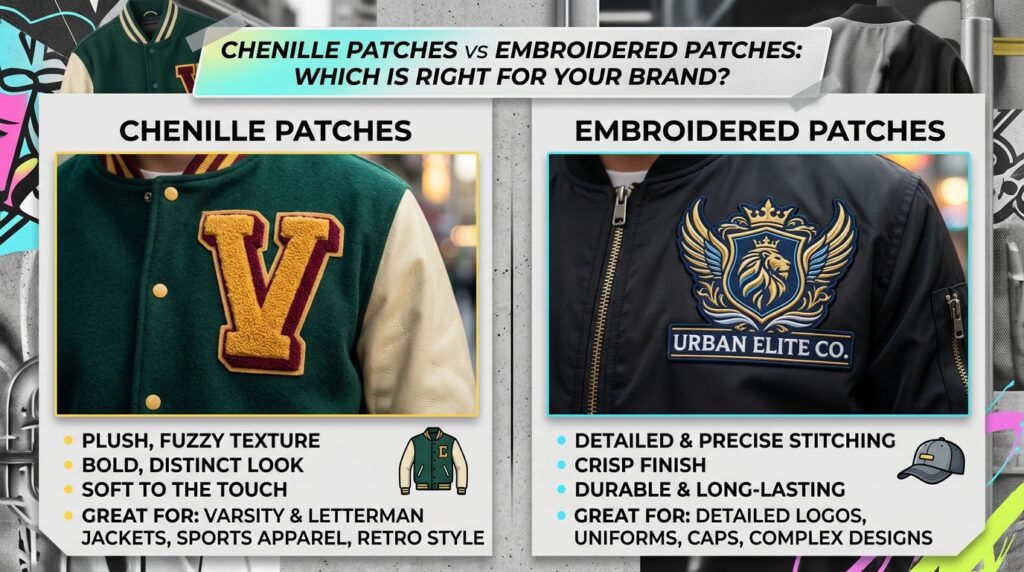
What Are Chenille Patches?
Chenille patches are characterized by their soft, fuzzy, towel-like texture. The word “chenille” comes from the French word for “caterpillar,” which perfectly describes the plush, velvety surface these patches create.
How Chenille Patches Are Made
Chenille patches are constructed using a specialized looped yarn technique. Instead of flat stitches sitting on top of a fabric base, chenille uses a loop pile system where yarn is fed through the backing to create raised, textured loops. These loops are then sheared (cut) or left intact depending on the desired effect, producing that iconic fuzzy surface.
The process requires dedicated chenille embroidery machines or attachments that can handle the thicker, bulkier yarn. At Gem Punch, our digitizers program separate stitch files for chenille elements because the density, pull compensation, and underlay requirements differ significantly from standard embroidery.
Common Uses for Chenille Patches
Chenille patches are most commonly associated with:
- Letterman jackets and varsity jackets — the classic athletic aesthetic
- Sports team awards — championship patches, MVP badges, and commemorative emblems
- Streetwear brands — oversized back patches, nostalgic 90s-inspired designs
- Schools and universities — academic achievement patches, club insignias
- Greek life organizations — fraternity and sorority jacket patches
The tactile, three-dimensional nature of chenille makes it ideal for designs that need to pop visually and physically. If you want someone to reach out and touch your patch, chenille is the answer.
What Are Embroidered Patches?
Embroidered patches are the industry standard. They use traditional flat stitching—typically rayon or polyester thread—to recreate a design on a twill or felt backing. The result is a clean, detailed, and versatile patch that works on nearly any garment or accessory.
How Embroidered Patches Are Made
Standard embroidered patches are created using computerized embroidery machines that read digitized stitch files (DST, PES, JEF, etc.). The digitizer maps every stitch: direction, density, type, and sequence. Common stitch types include:
- Satin stitches — for borders and clean lines
- Fill stitches — for large color areas
- Running stitches — for fine details and outlines
Embroidered patches can be produced with 50% thread coverage (classic look with visible backing) or 100% thread coverage (completely covered, premium appearance). They can also incorporate 3D puff embroidery for raised elements, though the texture differs from chenille’s soft fuzz.
Common Uses for Embroidered Patches
Embroidered patches dominate across virtually every industry:
- Corporate uniforms — left-chest logos, sleeve branding
- Military and tactical gear — morale patches, unit insignias, name tapes
- Motorcycle clubs — back patches, rocker panels, memorial patches
- Fashion and accessories — denim jackets, backpacks, hats
- Promotional merchandise — event giveaways, brand activations
- Sports teams — cap logos, jersey patches, fan merchandise
If chenille is the specialist, embroidered patches are the universal workhorse.
Chenille vs. Embroidered: Side-by-Side Comparison
| Feature | Chenille Patches | Embroidered Patches |
|---|---|---|
| Texture | Soft, fuzzy, looped pile | Flat, smooth, stitched surface |
| Visual Impact | Bold, retro, highly tactile | Clean, precise, professional |
| Detail Level | Best for large letters, simple shapes | Excellent for intricate logos, fine text |
| Color Blending | Limited; solid blocks work best | Advanced gradients and color transitions |
| Typical Size | Large (4″–12″) for maximum effect | Flexible (1″–15″+) |
| Backings | Sew-on, iron-on, velcro | Iron-on, sew-on, velcro, adhesive, magnetic |
| Durability | Very durable; loops can snag on sharp objects | Extremely durable; minimal snag risk |
| Cost | Higher (specialized machines, bulkier materials) | Lower to moderate (standard production) |
| Turnaround | Slightly longer (specialized setup) | Faster (standard workflow) |
| Best For | Varsity jackets, streetwear, nostalgia brands | Corporate, tactical, detailed logos, bulk orders |
When to Choose Chenille Patches
Chenille is not the right choice for every project—but when it fits, it dominates. Here are the scenarios where chenille patches outperform embroidered alternatives.
1. Varsity and Letterman Jackets
This is the classic use case. Letterman patches and varsity jacket patches are practically synonymous with chenille. The oversized, fuzzy letters spelling out team names, graduation years, or athletic achievements are instantly recognizable. If you are producing jackets for a school, sports team, or nostalgia-driven brand, chenille is non-negotiable.
2. Streetwear and Retro Fashion
In 2026, streetwear continues to mine 90s and Y2K aesthetics for inspiration. Chenille patches deliver that vintage, tactile look that flat embroidery simply cannot replicate. Brands like Supreme, Stüssy, and countless independent labels use chenille for oversized back patches that demand attention.
3. Awards and Commemorative Pieces
Because chenille feels premium and substantial, it is perfect for patches that celebrate milestones. Championship patches, hall-of-fame inductions, and anniversary badges all benefit from chenille’s weight and presence.
4. Designs with Large Typography
Chenille excels at rendering big, bold letters. If your design is primarily text-based—think “STATE CHAMPS,” “CLASS OF 2026,” or a brand name in block letters—chenille will look more impactful than embroidered text at the same scale.
5. Texture-First Branding
Some brands are built on sensory experiences. If your identity revolves around craftsmanship, heritage, or tactile luxury, the fuzzy surface of chenille reinforces that story every time someone touches it.
When to Choose Embroidered Patches
Embroidered patches are the safer, more flexible choice for the majority of projects. Here is where they shine.
1. Detailed Logos and Complex Artwork
If your design includes fine lines, small text, intricate borders, or multiple colors with gradients, embroidered patches are the only practical option. Chenille’s looped construction cannot reproduce details smaller than approximately 3–4 millimeters reliably. A detailed corporate logo with a tagline will look crisp in embroidery and muddy in chenille.
2. Small-Scale Applications
Need a 2-inch cap patch? A 1.5-inch uniform badge? Chenille does not scale down well—the loops become compressed and lose their signature texture. Embroidered patches work flawlessly at any size from one inch upward.
3. High-Volume, Budget-Conscious Orders
If you are ordering 500+ patches for a corporate event, employee uniform rollout, or promotional campaign, embroidered patches offer significantly better cost efficiency. The production process is standardized, thread costs are lower, and turnaround times are faster.
4. Tactical and Professional Gear
Military morale patches, law enforcement insignias, and corporate uniform badges prioritize readability and durability over texture. Embroidered patches withstand harsh washing, abrasion, and environmental exposure without snagging or matting.
5. Versatile Placement
Embroidered patches adhere cleanly to hats, backpacks, polos, dress shirts, and even delicate fabrics. Chenille’s bulk and weight limit it to heavier garments like wool jackets, denim, and canvas.
Cost Comparison: What to Expect
Pricing varies based on size, quantity, colors, and backing type, but here is a general framework based on Gem Punch’s 2026 pricing:
| Size | Chenille Patch (per unit, 50 qty) | Embroidered Patch (per unit, 50 qty) |
|---|---|---|
| 3″ | $8–$14 | $4–$7 |
| 5″ | $12–$20 | $6–$10 |
| 8″ | $18–$30 | $10–$16 |
| 12″ | $28–$45 | $16–$25 |
Why the difference? Chenille requires specialized machinery, thicker yarn, more material weight, and longer production time. The digitizing process is also more complex because the digitizer must account for loop height, pile direction, and compression factors that do not exist in flat embroidery.
For bulk orders of 250+ units, the per-unit cost gap narrows, but embroidered patches remain the more economical choice.
Design Limitations and Capabilities
Understanding what each patch type can and cannot do will save you from expensive redesigns.
Chenille Limitations
- No fine detail: Text below 0.25″ height will be illegible. Thin lines and intricate borders are not achievable.
- Limited color blending: Chenille works best with solid, contrasting color blocks. Gradients and shading are effectively impossible.
- Size minimum: Chenille needs room to show its texture. Patches smaller than 3″ rarely look impressive.
- Weight: Chenille patches are heavier and can pull down lightweight fabrics.
Embroidered Limitations
- Flat appearance: Without 3D puff or special techniques, embroidered patches lack physical depth.
- Thread sheen: Rayon thread has a distinctive shine that may not match matte brand guidelines.
- Large solid areas: Filling a 6″ patch with satin stitches can look stiff and create tension issues on the garment.
Hybrid Designs: The Best of Both Worlds
Many of Gem Punch’s most successful projects combine both techniques. A varsity jacket might feature a large chenille team name across the back with embroidered sleeve patches for player numbers and sponsor logos. A streetwear brand might use chenille for the main graphic and embroidered satin borders for clean edges.
If your design has both bold typographic elements and detailed iconography, ask your digitizer about mixed-media patches. They cost more and require advanced production, but the result is unmatched.
Durability and Care
Both patch types are built to last, but their care requirements differ.
Chenille patches should be washed inside-out on gentle cycles. The loops can snag on zippers, Velcro, or sharp edges during machine washing. Avoid high-heat drying, which can flatten the pile over time. With proper care, a chenille patch will last 5–10 years before showing significant wear.
Embroidered patches are virtually indestructible under normal conditions. They withstand industrial washing, dry cleaning, and heavy abrasion. The primary failure point is the backing adhesive (for iron-on versions) rather than the stitching itself. Sew-on embroidered patches often outlast the garment they are attached to.
Trends: Where Chenille and Embroidery Are Heading
The custom patch industry is evolving rapidly. Here are the trends shaping how brands use chenille and embroidered patches this year:
1. Oversized Chenille in Streetwear
Brands are pushing chenille patches to 10″–14″ back-panel sizes for maximum visual impact. The bigger the patch, the more the texture reads as luxury.
2. Sustainable Materials
Both patch types are now available with organic cotton twill backings, recycled polyester threads, and PVC-free alternatives. Eco-conscious brands are requesting these options for 2026 collections.
3. Hybrid Puff + Chenille
A new technique combines 3D puff embroidery with chenille loops to create patches with multiple elevation levels. This is especially popular for limited-edition streetwear drops.
4. Nostalgia-Driven Varsity Revival
Letterman jackets are back in mainstream fashion—not just for athletes. Fashion brands are creating “faux varsity” lines with authentic chenille patches to sell the aesthetic without the athletic affiliation.
5. Minimalist Embroidery
On the embroidered side, brands are moving toward smaller, more subtle left-chest logos with 100% thread coverage for a premium, badge-like appearance.
How to Order: Tips for a Smooth Process
Whether you choose chenille or embroidered, follow these steps to avoid costly revisions:
- Start with vector art: Send AI, EPS, or SVG files. Chenille especially requires clean vector paths because the digitizer needs to define loop zones precisely.
- Specify the garment: A patch digitized for a wool varsity jacket will not sew the same way on a lightweight nylon windbreaker. Fabric weight matters.
- Request a physical sample: For orders over 100 units, always approve a production sample before full manufacturing. Chenille colors can look different under factory lighting than on screen.
- Choose the right backing: Sew-on is most durable for both types. Iron-on works for embroidered patches on stable fabrics. Velcro is ideal for tactical and removable applications.
- Trust your digitizer: Chenille digitizing is a specialized skill. If your provider does not ask about loop height, pile direction, and compression ratios, find one who does.
Frequently Asked Questions
Can you combine chenille and embroidery in one patch?
Yes. Mixed-media patches are increasingly popular, especially for varsity jackets and streetwear. The digitizer must plan the stitch sequence carefully so the chenille loops do not interfere with embroidered elements.
Are chenille patches only for jackets?
Primarily, yes. Chenille’s weight and bulk make it unsuitable for lightweight shirts, hats, or delicate fabrics. It works best on wool, denim, canvas, and heavy cotton.
Which patch type is more expensive?
Chenille is consistently 40–60% more expensive than embroidered patches at equivalent sizes and quantities due to specialized machinery, thicker materials, and longer production times.
How small can text be in a chenille patch?
Text should be no smaller than 0.25″ (6mm) in height for chenille. Anything smaller will be illegible because the loops merge together. Embroidered patches can handle text down to 0.125″ (3mm) with proper digitizing.
Can I get a single chenille patch as a sample?
Most manufacturers—including Gem Punch—require a minimum order for chenille due to the machine setup time. However, we offer sample programs for qualified bulk orders. Contact us for specifics.
Final Verdict
Choose chenille patches when you want bold, tactile, nostalgic impact—ideal for varsity jackets, streetwear back panels, and commemorative pieces where texture is the selling point.
Choose embroidered patches when you need detail, versatility, cost efficiency, and universal compatibility—ideal for corporate branding, tactical gear, detailed logos, and high-volume orders.
Still unsure? Send your artwork to Gem Punch and our digitizers will recommend the optimal patch type, size, and construction for your specific design and budget. We have produced thousands of both chenille and embroidered patches for brands, teams, and organizations worldwide—and we will make sure your patch tells your story exactly the way you envision it.
Ready to start your order? Get a free quote and digital mockup from Gem Punch today.