A biker patch is a piece of embroidered fabric. That is all it is, technically. And yet few objects in American cultural history carry as much meaning, as much contested territory, or as much earned respect as the patches sewn onto the back of a motorcycle vest.
The history of biker patches is inseparable from the history of motorcycle club culture itself — a story that begins with returning World War II veterans, runs through the outlaw rebellions of the 1950s and 1960s, and continues today in a global culture of riders who use patches to communicate identity, loyalty, and belonging in ways that words alone cannot.
This is that story — told decade by decade, from the earliest riding clubs to the custom patch designs.
Biker patches are not a single uniform tradition. Different clubs, regions, and cultures have developed their own systems of patch meaning and etiquette. This guide covers the dominant traditions rooted in American motorcycle club culture, which form the foundation of global biker patch culture today.
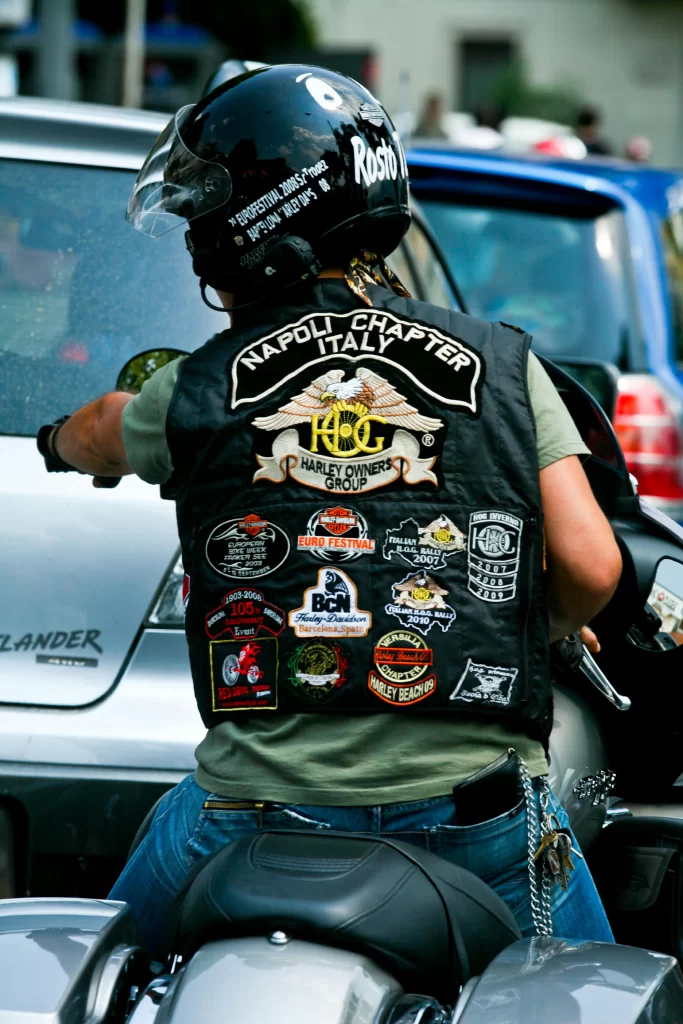
The Origins: Military Insignia and the Birth of Motorcycle Clubs (1900s–1940s)
To understand where biker patches came from, you first need to understand where bikers came from. The earliest motorcycle clubs in America formed in the early 1900s, shortly after the invention of the motorcycle itself. The American Motorcyclist Association (AMA) was founded in 1924, bringing together riding enthusiasts under a single national organization.
From the beginning, these clubs borrowed heavily from military culture — and for good reason. Many early riders were veterans or active military personnel who were drawn to motorcycles for the same reasons they had been drawn to military service: the brotherhood, the discipline, the sense of shared mission. Military insignia had long served as a way to identify unit affiliation, rank, and achievement. Early motorcycle clubs adopted the same logic — patches and badges on jackets and vests that told other riders who you were, who you rode with, and what you had done.
These early patches were simple — often just a club name or logo stitched onto a jacket back. But they established the fundamental idea that would define biker culture for the next century: your patch is your identity on the road.
The Turning Point: Post-World War II and the Rise of Outlaw Culture (1945–1955)
The period immediately following World War II was the most consequential in the history of biker patches. Hundreds of thousands of veterans returned home from the war having experienced levels of camaraderie, danger, and freedom that civilian life simply could not match. Many found solace on motorcycles — the closest thing to the freedom and intensity of the war they had left behind.
Motorcycle clubs formed rapidly across the country. Most operated within the AMA’s framework, adhering to its codes of conduct and participating in sanctioned events. But a significant number did not. These riders — who would come to be called outlaw clubs — rejected the AMA’s authority and the mainstream values it represented.
The defining moment came in 1947 at the Hollister Rally in California, where a group of riders from the Pissed Off Bastards of Bloomington caused a significant disturbance. The event was sensationalized in the press and became a cultural flashpoint. In the aftermath, the AMA reportedly stated that 99% of motorcyclists were law-abiding citizens — implying that the remaining 1% were not. Outlaw clubs embraced this framing, and the 1% patch was born.
It was also during this period that the three-piece patch configuration emerged as the defining symbol of outlaw motorcycle club identity. Where AMA clubs wore simple one-piece patches, the outlaw clubs divided their back patch into three distinct elements — top rocker, center emblem, and bottom rocker — each carrying specific meaning about the club’s name, identity, and territory.
The three-piece patch was not just a design choice. It was a declaration of independence from mainstream motorcycle culture and the values it represented. Wearing colors meant you had earned a place in a brotherhood that operated by its own rules.
The 1950s and 1960s: Consolidation and the Golden Age of Club Culture
Through the 1950s and into the 1960s, the major outlaw motorcycle clubs that would define the culture solidified their identities and their patch systems. Clubs like the Hells Angels (founded in 1948), the Outlaws (founded in 1935 but fully patched in this era), the Pagans, and the Bandidos developed the patch traditions that most closely resemble what MC culture looks like today.
During this period, patches became increasingly complex and regulated. Each element — the top rocker, center patch, bottom rocker, and the growing number of smaller patches that accompanied them — was assigned specific meaning. Officer designations (President, Vice President, Sergeant-at-Arms) appeared as chest patches. Memorial patches for fallen members became standard. Achievement patches were awarded for specific acts of loyalty or service to the club.
The colors became something sacred. A member’s patches represented not just their affiliation but their standing, their history, and their commitment to the brotherhood. The rule that colors must be surrendered when a member leaves the club — rather than kept as personal property — dates to this era. Colors belonged to the club, not the individual.
| 1924 | American Motorcyclist Association (AMA) founded — first organized framework for US motorcycle clubs |
| 1935 | The Outlaws MC formed in Illinois — one of the earliest outlaw clubs |
| 1945–48 | Mass veteran return from WWII — motorcycle club formation accelerates rapidly across the US |
| 1947 | Hollister Rally — the cultural flashpoint that defined outlaw motorcycle identity |
| 1948 | Hells Angels MC founded in Fontana, California — three-piece patch system adopted |
| 1950s | Three-piece patch becomes the universal symbol of outlaw MC status |
| 1960s | Major clubs expand nationally and internationally — patch systems become highly regulated |
| 1970s | Biker culture enters mainstream consciousness through film and media |
| 1980s–90s | Custom patch manufacturing industry grows — wider access to embroidery technology |
| 2000s | Internet era opens global access to patch culture — riding clubs proliferate worldwide |
| 2010s | PVC and woven patches become popular alternatives to embroidery |
| 2020s | Custom patch design reaches new levels of sophistication — digital tools transform production |
The 1970s: Biker Culture Goes Mainstream
The 1970s brought motorcycle culture into the mainstream American consciousness in an unprecedented way. Films like Easy Rider (1969, but dominant in the 70s cultural conversation) and later The Wild One romanticized the biker lifestyle and brought the imagery of motorcycle patches to a mass audience that had previously only seen it from a distance.
This mainstream visibility had a double-edged effect on patch culture. On one hand, it brought new riders into the fold and expanded motorcycle club membership. On the other hand, it created a market for biker imagery that was completely divorced from the culture itself — patch designs, leather vests, and club-style insignia sold as fashion items to people who had no connection to actual motorcycle clubs.
This tension between authentic patch culture and its commercial imitations has defined the relationship between the biker community and mainstream culture ever since.
The 1980s and 1990s: Technology Changes Everything
The embroidery technology of the 1980s and 1990s transformed what was possible in patch design. Computer-aided embroidery systems — which allowed designs to be digitized and reproduced with machine precision — dramatically expanded the complexity, color range, and detail achievable in a custom patch.
Where earlier patches had been limited by the constraints of hand or simple machine embroidery, the new technology allowed for photorealistic portraits, complex multi-color designs, and fine detail work that would have been impossible to produce at scale a decade earlier. Custom patch manufacturers expanded rapidly, and the quality ceiling for what a club could put on its members’ vests rose significantly.
This era also saw the emergence of the custom patch industry as a distinct commercial sector — with specialist manufacturers offering production services to clubs, military units, law enforcement agencies, and eventually the broader public.
The 2000s: The Internet Era and the Global Spread of Patch Culture
The internet era fundamentally changed the landscape of biker patch culture in ways that are still playing out today. For the first time, riders in rural areas, outside the US, and without access to established club networks could connect with patch culture, order custom patches, and learn the traditions and rules that governed them.
The global spread of American motorcycle club culture accelerated dramatically. Chapters of major American clubs opened across Europe, Australia, South America, and Asia. Local clubs in countries with no prior MC tradition adopted the three-piece patch system and the associated etiquette, creating genuinely international networks of club culture.
The internet also created new challenges around patch authenticity and etiquette enforcement. With custom patches available to order online from anywhere in the world, the cultural gatekeeping that had previously been enforced through physical presence and local reputation became harder to maintain.
Modern Patch Types and Materials (2010s–2026)
Today, biker patches are produced in a wider range of materials and techniques than at any point in their history. While traditional embroidered patches remain the standard for most motorcycle clubs, several alternatives have become popular across the broader riding community:
Embroidered patches
Still the gold standard for MC colors and formal club patches. High stitch count embroidery produces rich, durable designs that maintain their appearance over years of riding. Modern embroidery digitizing allows for extraordinarily detailed designs at competitive prices.
PVC patches
Molded rubber patches that offer a tactile, three-dimensional quality not achievable with embroidery. Increasingly popular for morale patches, riding club designs, and patches that need to withstand extreme weather conditions. PVC patches are waterproof, UV-resistant, and highly durable.
Woven patches
Produced on a loom rather than embroidered, woven patches achieve finer detail at smaller sizes — making them ideal for small text, intricate linework, and designs with many colors. Woven patches have a flatter, more textile-like appearance than embroidered patches.
Leather patches
Laser-cut or stamped leather patches offer a rugged, traditional aesthetic that sits naturally on leather vests. Popular for name patches, chapter designations, and smaller accent patches. Leather patches have seen a significant resurgence in popularity since the early 2010s.
| Patch Type | Best Used For |
| Embroidered | Club colors, back patches, formal designations |
| PVC | Morale patches, weather-exposed applications, detailed 3D designs |
| Woven | Fine detail designs, small text, high color count designs |
| Leather | Name patches, accent patches, traditional aesthetic applications |
| Printed | Photo-realistic designs, temporary applications, event patches |
The Cultural Significance of Biker Patches Today
In 2026, biker patches carry a cultural weight that goes far beyond the motorcycle community. They have influenced fashion, military culture, sports team identity, and the broader custom merchandise industry. The language of patches — the idea that a piece of embroidered fabric can carry earned meaning, represent loyalty, and communicate identity in an instant — has spread into nearly every corner of culture.
But for the riders who wear them in the original tradition, the meaning remains unchanged. A patch on the back of a vest represents something earned through time, loyalty, and commitment. It is a visual biography — a record of where you have been, who you ride with, and what you stand for.
The three-piece patch still carries the same weight it has carried since the 1950s. The rules around wearing colors, respecting territory, and earning rather than buying your patches remain as significant as they have ever been. Technology has changed how patches are made. It has not changed what they mean.
Current Trends in Biker Patch Design
- Hyper-detailed embroidery — advances in digitizing allow stitch counts and detail levels previously impossible at commercial scales
- Glow-in-the-dark thread — increasingly popular for night-ride patches and event commemoratives
- Minimalist designs — a countercurrent to the maximalist tradition, featuring clean geometric designs and limited color palettes
- Mixed-media patches — combining embroidery with PVC elements, metal hardware, or leather backing for dimensional effects
- Memorial and tribute patches — growing demand for detailed portrait patches honoring fallen members
- Sustainable materials — eco-conscious clubs seeking recycled or organic thread and backing options
Frequently Asked Questions
When did biker patches first appear?
The earliest motorcycle club patches appeared in the 1920s and 1930s alongside the formation of the first organized riding clubs. The patch traditions most recognizable today — particularly the three-piece system — developed in the late 1940s and 1950s following World War II.
What was the first motorcycle club to use three-piece patches?
The Hells Angels, founded in Fontana, California in 1948, are widely credited with establishing the three-piece patch as the defining symbol of outlaw motorcycle club identity. The configuration — top rocker, center emblem, bottom rocker — was adopted by other outlaw clubs throughout the 1950s.
Why do biker patches have such strict rules?
The rules around biker patches developed organically from the culture’s emphasis on earned identity, territorial respect, and brotherhood. Patches represent genuine membership and loyalty — allowing non-members to wear similar patches would undermine the entire system of meaning. The rules exist to protect the integrity of what the patches represent.
Has the meaning of biker patches changed over time?
The specific designs and configurations have evolved, but the core meaning of biker patches has remained remarkably consistent since the 1950s. Patches still primarily represent club affiliation, earned membership, territory, rank, and personal achievement. What has changed is the breadth of patch culture — it has expanded well beyond outlaw MC culture into riding clubs, independent riders, and the broader custom patch market.
What is the future of biker patches?
Embroidery technology continues to advance, enabling finer detail and more complex designs at lower costs. PVC and mixed-media patches are growing in popularity. But the fundamental tradition — earned patches representing real membership and real loyalty — shows no signs of changing. If anything, the proliferation of fashion patches has made authentic club patches more meaningful by contrast.
Final Thoughts
The history of biker patches is a history of identity. From the simple sewn badges of the first riding clubs to the tightly regulated colors of modern motorcycle clubs, patches have always served the same purpose — to tell the world who you are, who you ride with, and what you have earned the right to display.
That purpose is as relevant in 2026 as it was in 1948. The materials have changed. The designs have evolved. The technology has transformed what is possible. But the meaning at the heart of every patch — earned, not bought; worn, not displayed; respected, not imitated — remains exactly what it has always been.
Gem Punch has produced custom embroidered and PVC patches for motorcycle clubs worldwide for over 13 years. If your club needs new colors, memorial patches, officer designations, or chapter patches — we understand the culture and deliver production-quality results. Get a free quote at gempunch.com.